Wednesday, May 2, 2012

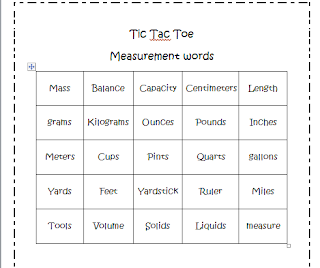
Tic Tac Toe

This is an activity that goes far beyond just memorizing meanings of words...it lets kids make connections!!!  You can do this as a pre-assessment, a quick check mid-way through a unit or prior to a test...

How does it work?

Give students a list of vocabulary words on index cards or small cards on cardstock.
Students will shuffle the cards and deal out nine cards in a 3X3 format.

Ask student to form eight sentence each (orally), including the three words straight across in a row, straight down in a column, or a diagonal.

Then share the best sentence that made the most connections or misconceptions between words and concepts listed.


By the way, the vocabulary idea packet is available now!  Click on here to pick it up today!

Tuesday, May 1, 2012

Five Card Draw

How does this work?

Prepare cards with vocabulary words from any set of categories.  Today I am sharing math vocabulary words. 

Pass out the word cards to each student in the room. 

Then ask the students to move around the room to find four other students who have words that should "fit" into their category.

Once they find their matches, ask the groups to prepare a poster to summarize what they know about their category.  Include a picture or diagram, examples of the math (equations, graphs,etc...) and at least one sentence to explain the category.

This pdf will be available for FREE at the end of this week's postings....

Monday, April 30, 2012

Do you sort cards???

This strategy is a great one for sharing ideas and building vocabulary.  It takes minimum prep work and materials, too!  All you need are index cards and markers or pencils.

Here's what to do:

Students work by themselves to generate words or phrases that come to mind when they think of a certain topic.  They record these words on separate index cards. 

Then in a small group, students share the words they thought of and eliminate duplicates.

Students then sort the ideas into categories - the categories can be created by the students or the teacher.

Finally after the groups are done, take a walk around the room to see what each group has sorted. 

As a whole class, debrief....what did you notice? what surprised you? what would you change?


What does it look like in a real classroom???  I used it this week as a review before an end of unit test....

1. I asked the kids to brainstorm as many words and/or phrases as they could think of about the Civil War.  They could use their notebooks for support.
2.  Next, they worked in the group to eliminate duplicates.
3.  I gave them the categories to sort by -   North, South, West Virginia, Battles, Leaders, and Roles of Virginians.
4.  Then we did the gallery walk and debrief.

Total time was about 20 minutes...we made lots of connections across categories too!

Saturday, April 28, 2012

Inside Outside Circles....

Last weekend, I had a brainstorm...to talk this week about vocabulary strategies...I planned to talk about a different one a couple of days this week.  And then, life hit...I can't even say I had any thing special, but I seemed to be super busy!  My goal this weekend is to try and get the posts written so I can just press publish during the week.

Anyway....we are getting close to state testing time and the main thing we are noticing with our kids at risk of passing is that their vocabulary is weak.  No surprise right?

One way you can build this is using Inside Outside Circles. Now, this works best if you have a lot of room in your classroom to make a large circle.  You have half of your students make the outside circle and match them up with another student to make the inside circle. It looks something like this:

There are many ways you can use this format as I am sure you know...for review, spelling words, sharing weekend news, as a greeting... (for more ideas see this link)

Here is the way I use it to help build vocabulary in my classroom... First I pick a topic or category such as Holidays. Then we face each other and students on the outside circle share their word such as Christmas.  The person across from them then says a words that reminds them of that holiday - such as presents.  Then the outside circle moves to the next person.  I repeat the category "holiday" and they can either use the same holiday or choose another one.  The person on the inside circle will say a word that they think of. 

Why do I do this?  Well, I have found that a) it is fun and b) it allows our language rich students to expose our language poor students to new words in a fun and non-threatening way. 

I have created a PDF with a list of categories that will be available for FREE along with the other vocab strategies that I am going to feature this week.  It will be posted very soon on my TPT store. 

I hope you can use these to engage students in your classroom.

Sunday, April 22, 2012

Active Learning strategies...to build vocabulary

Let's talk...

Vocabulary...it's a make or break thing.  In my experience as a mother, it's pretty easy to build vocabulary with little kids...by talking to them.  You talk to them from the minute they are born - at the grocery store, the park, the mall...You talk to them when you read aloud books and they look at you with their sweet little eyes and say "what that mean mommy?"  You talk with them when you watch TV, movies, over dinner and at bedtime. Words surround your life...

But so many of our kids are lacking this experience.  Without judging...it is a problem in many households across the United States - mainly in our homes that struggle with poverty.  So how do you recreate those years of talking about words in your classroom? 

I think you have to be very mindful of how you do it.   I have a selection of students with a weak vocabulary who I purposefully meet with at least three times a week.  We read through a short passage and highlight words that we don't know the meanings for.  Then...just like I did with my babies, we talk.  We talk about what they mean, when you would see them...some times we "Google" the word to find an image to put a visual in their head.  Here's the thing - I do nothing to prepare for this except pick a passage on their reading level.  I have found that pre-teaching 8 prescribed words is not very effective for language weak kids.  For one thing, these may not be the words that they struggle with. For another, they have no ownership on the task. 


Some other activities that promote ownership of the language and exposure include Word Splashes & Graffiti walls which I have blogged about previously. 

This week I'm going to highlight a few other ways to get meaningful language embedded in our classrooms on a daily basis.

  • Using Inside-Outside Circles
  • Sort Cards
  • Five Card Draw
  • Tic-Tac-Toe
Hope they will help you engage your students.


Saturday, April 21, 2012

Test Taking Motivation

  It is officially 20 days until state testing time and we are in crunch time. Do you know what we call our standards in Va?  SOLs (Standards of Learning).  I know, I know...giggle giggle...it sounds like something else. 
  How do you review with your students?  Do you have Study Island?  Study island is a great website with games geared specifically to our standards.  You can access it on a regular computer, as well as an app for your ipad, kindle or other device.
We have created a study calendar with our students that breaks down our standards into smaller chunks and assigns different practice sessions using the computer on Study Island.  My own research shows that the kids who studied this way...a little bit each night over a course of a few weeks...scored better on the test than those who did not.  Of course, not every child has access to a computer every night. And so we also included a paper version of refrigerator cards for Virginia Studies, as well as skill specific review worksheets for math/reading (one a night).

Then you have to think....how do I get them to actually do it...you know, study???
Well we came up with this idea last year and it really worked. 

Our school uses Responsive Classroom and therefore we do not use ticket systems or prize boxes during the year.  However, for the four weeks before testing...we do...kinda.

Here is the plan...I made up a grid using a pocket chart that I duct taped to the wall with fancy tape.

Across the top it says S O L *(star) and down the side it is numbered 1 - 8. 

Then I took some two sided chips and wrote a letter or * on one side and the corresponding numbers on the other. To explain ...think of bingo chips like S 1, S 2, S 3, S 4 , S5, S6, etc...

Next, each day the students come in with their folder that houses the calendar.  If they have studied using the papers, then their parents need to initial it.  If they have studies on the computer (Study Island) I can check the results, see their scores and get my proof that they did indeed study. 
If they are in the clear, they can put their name on the chart.
Here is the fun part...then I pull a chip from the basket and call out a coordinate.  S-5.  If there is a student's name in there...then they get to choose from the prize bucket.  If not, I draw again. 
Now, I am a softy and therefore I pick two names a day.  I let the students know that it is totally random and you can get called at any time.  (This keeps them on their toes to study every day!)  I also tell them every one who studies will be rewarded at the end with a really good SOL score...as well as a treat from me!
We switched to this method for several reasons...one - they need motivation at this time of year.  (me too!) two - we used to use a pizza party for everyone who studied at the end...but that was too long to wait and after a while, some kids quit trying.  three - let's face it, our jobs are on the lines with these scores...we've got to do everything we can to get them to study and pass.

I have to say that I had several students in the past two year's class who took this to heart and really used this time to get caught up.  I had one child who had been retained twice and really struggled...she not only passed all three tests, she passed one with an advanced score. 

I hope it helps to engage your students during CRUNCH TIME....
Wednesday, April 18, 2012

Exit Cards...

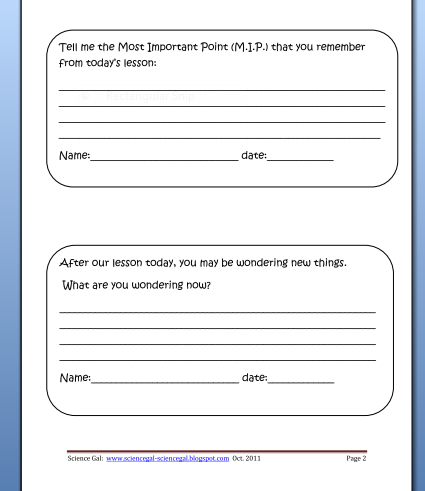
Another way to have students summarize their thinking is through exit cards.  I have created a packet of exit cards that I use with science that you can down load for free.

In this packet I put together some of my favorite summary stems including....MIPS (most important point),  3,2,1 charts,
wonderings, questions, and reflections..  You can copy these and pass them out, or you can simply write them on the board for your students to copy on index cards. 
.

Exit cards do not need to be anything elaborate...but they do need to be analyzed.  They are a great way to see who got it, who may still be somewhat confused, and who is really lost.  I often take the cards with me at lunch and quickly read them and sort them into three categories.

Sometimes my team mates and I will come up with a math problem that we will give at the end of a lesson so we can see who needs reteaching. We use the exit cards to split kids up into formative teaching groups among the team.  It really works!!

Enjoy engaging your learners...